

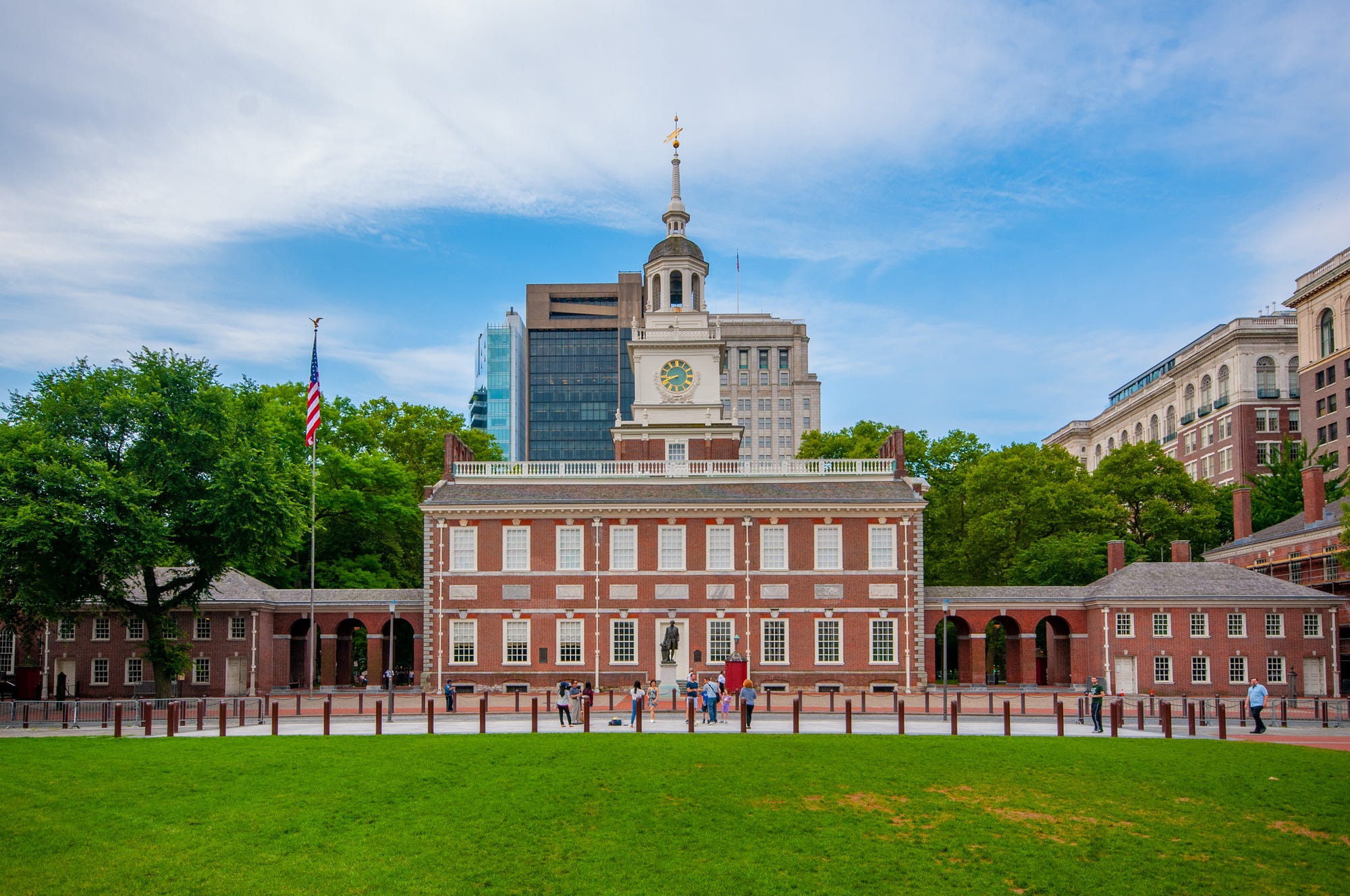
Hopefully, Nicolas Cage wouldn’t steal the document this time, like he did in 2004’s implausible adventure movie National Treasure.
What the bill does
New legislation would convene Congress at Philadelphia’s Independence Hall, the site of the Declaration of Independence’s signing on July 4, 1776, for the 250th anniversary on July 2, 2026.
Why not on July 4, the exact anniversary? Because in 2026, that date will fall on a weekend Saturday, when Congress would likely be out of session.
The legislation was introduced by Rep. Brendan Boyle (D-PA2), who represents the district of Philadelphia containing Independence Hall itself. The legislation does not appear to have an “official” title.
Context: outside D.C.
Congress has twice convened in cities beyond Washington, D.C. for special occasions.
On July 16, 1987, Congress met at Independence Hall for the 200th anniversary of the Constitution — not the entire Congress, but 55 members of the House and Senate. C-SPAN broadcast the event on television.
On September 6, 2002, Congress met at Federal Hall in New York City, for the one-year anniversary of the 9/11 terrorist attacks on the World Trade Center. Though more than half of Congress attended, around 300 members, that still fell short of the entire body. C-SPAN broadcast that event, too.
Context: the Declaration
Written by Thomas Jefferson, later elected as the third president, the Declaration of Independence detailed colonists’ grievances against King George III and explained why they declared a revolution against his rule. Jefferson’s opening phrase became one of the most famous in American history: “When in the course of human events.”
56 delegates to the Continental Congress signed the document, including some of the most prominent men of the era like Benjamin Franklin, John Adams, and Jefferson. John Hancock famously signed his name extra large, reportedly so that the king could see it all the way from England.
Today, the document is on display to the public at the National Archives in Washington, D.C. and the signing is celebrated annually as the federal holiday Independence Day.
(Although recently, historian Andrew Roberts prompted something of a reconsideration when he argued in his 2021 biography The Last King of America that King George III wasn’t actually that bad.)
What supporters say
The bill’s supporters argue that it’s fitting to mark the entire origin point of the American experiment in the room where it all began.
“In 1776, Philadelphia was the birthplace of American democracy,” Rep. Boyle said in a press release. “It is only right that we celebrate our nation’s 250th anniversary in the very building where the Continental Congress signed the Declaration of Independence. Our bill will bring Congress together in Philadelphia once again for a historic special session to honor 250 years of freedom.”
What opponents say
While unable to locate any explicit statements of opposition, perhaps some could object to one of the lead Democratic sponsor’s seemingly anti-Trump arguments.
“Both abroad and at home, we are seeing threats to democracy today in a way which hasn’t been the case at any point in my lifetime,” Rep. Boyle told the Philadelphia Inquirer in 2024 upon introducing a prior version of the legislation. (His phrase “and at home” clearly referenced President Donald Trump.) “So I think this takes on greater symbolic value to remind all of us of the spirit of 1776, what our founders achieved, and how precious it is in this generation that we don’t lose it.”
What happens next
The legislation has attracted 28 bipartisan cosponsors: an exactly even mix of 14 Democrats and 14 Republicans. Notably, almost half — or 13 of the 28 — hail from Pennsylvania.
It’s been referred to the House Judiciary Committee.
Rep. Boyle previously introduced a prior version of the legislation in late June 2024. It attracted a slightly larger 28 bipartisan cosponsors, 20 Democrats and eight Republicans, but never received a committee vote.
This article was originally published by The Fulcrum, republished under their guidelines. I wrote it.