

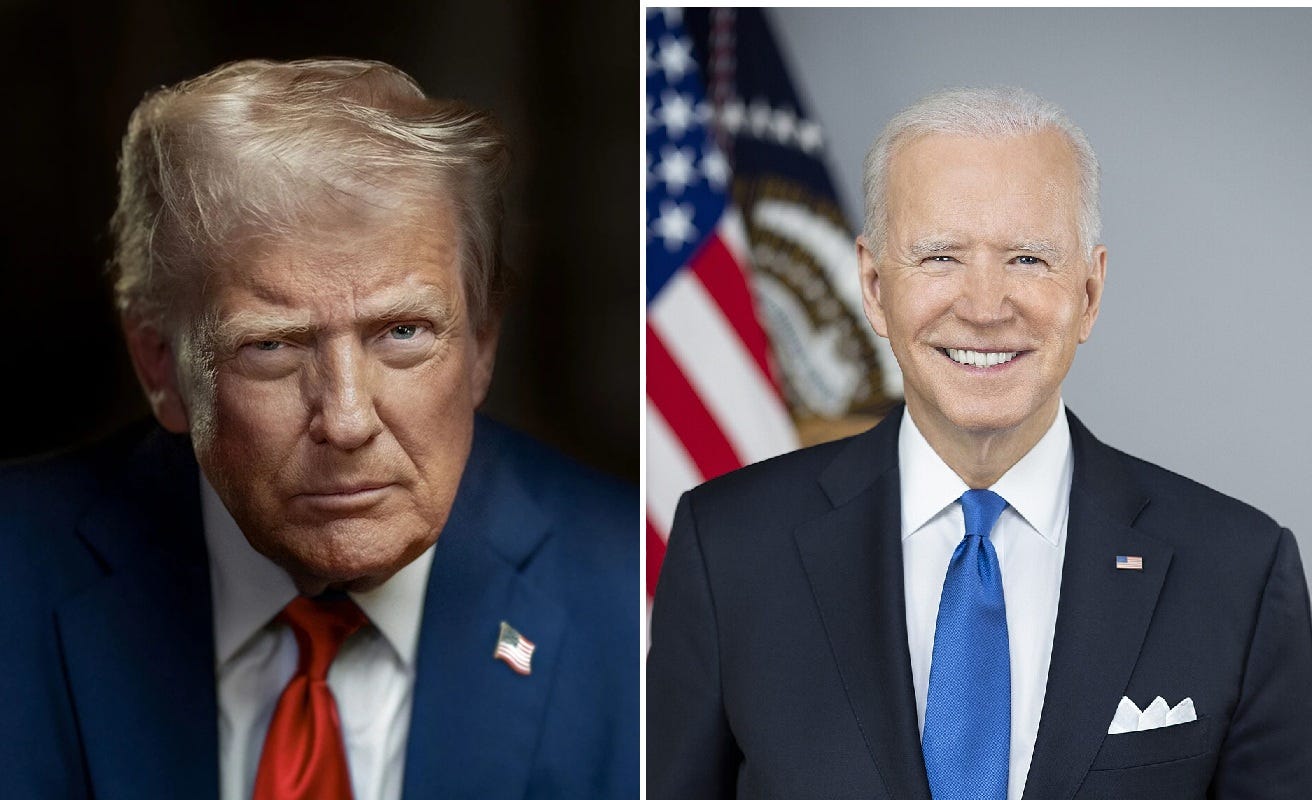
It’s not just Trump and Biden – such a commission would likely have ruled against historical presidents Woodrow Wilson and William Henry Harrison too.
What the bill does
The Commission on Presidential Capacity to Discharge the Powers and Duties of the Office Act would create an independent committee to officially determine if a president is cognitively and medically fit to serve.
This committee would be permanent, meaning it would apply to any president moving forward, not just Donald Trump.
The 17 members would comprise:
Four doctors
Four psychiatrists
Eight former executive branch officials, each of whom had to previously serve in one of seven specified positions:
President
Vice president
Secretary of State
Attorney General
Treasury Secretary
Defense Secretary
Surgeon General
A 17th member selected by the other 16 members
The first 16 members would be selected in equal measure by Republican and Democratic congressional leadership, providing exactly even bipartisanship. None of those members could be current elected politicians, federal employees, or military members.
The 17th and final member might serve to break ties, but would presumably be a more nonpartisan figure “above the fray,” since they’d have to be elected by the other 16.
Rep. Jamie Raskin (D-MD8) introduced a House version on April 14.
Context: the 25th Amendment
After President John F. Kennedy’s 1963 assassination, a troubling what-if scenario emerged: what if the bullet had landed an inch or two away, putting Kennedy in a coma instead of killing him?
Would Kennedy still be considered “the president,” even if he was functionally brain-dead ? What if such a condition lasted for years to come?
So in 1967, only a little more than three years later, the Constitution’s 25th Amendment clarified the rules of presidential succession.
One of its provisions specifies what happens if the president is deemed “unable to discharge the powers and duties of his office” – even if they’re still alive. Since then, that provision has never been “seriously” invoked.
(Although Presidents Ronald Reagan and George W. Bush did it invoke it briefly when they underwent medical procedures involving anesthesia, giving the vice president the powers of the presidency for only those few hours.)
Who decides?
That still leaves the question: who decides that the president is in a condition where they’re alive but functionally unable to serve?
The question has risen to the fore in recent years. The last two presidents, Trump and Joe Biden, are the two oldest presidents in U.S. history and both experienced accusations of cognitive decline. Biden was 82 on his last day in office, the same age Trump will be on his last day if he serves until then.
In those above examples, Presidents Reagan and Bush both voluntarily agreed to give up their power for several hours. But what if the president doesn’t agree, and has to be forcibly removed from their post? The equivalent of “Mom (or Dad), I’m taking your car keys. It’s for your own good.”
The 25th Amendment allows three possibilities for who can make that judgment.
The president’s own inner circle: the vice president plus a majority of the Cabinet secretaries.
The legislative branch: two-thirds of both the House and the Senate.
A more nonpartisan option: an independent panel created by Congress.
In the 59 years since the amendment was ratified, Congress has never actually created such a panel. Now they might.
What supporters say
Democrats say that Trump poses an unprecedented challenge, in their view. He’s on track to become the oldest president ever, a few months older than even Biden was at the end. Also, his second-term vice president J.D. Vance and Cabinet seem particularly unwilling to publicly break from him.
Meanwhile, it’s almost impossible to imagine two-thirds of both the House and Senate voting to remove a president, whether Trump or any president. Assuming such a vote would likely be party-line or close to it, neither party has controlled a two-thirds congressional majority since the 1960s.
“Public trust in Donald Trump’s ability to meet the duties of his office has dropped to unprecedented lows as he threatens to destroy entire civilizations, aggressively insults the Pope of the Catholic Church, and sends out artistic renderings online likening himself to Jesus Christ,” Rep. Raskin said in a press release. “We are at a dangerous precipice.”
“It is now a matter of national security for Congress to fulfill its responsibilities under the 25th Amendment to protect the American people from an increasingly volatile and unstable situation,” Rep. Raskin continued.
What opponents say
Republican opponents counter that the legislation is solely meant to embarrass President Trump. Indeed, the bill’s 84 cosponsors are entirely Democratic.
Sure enough, Rep. Raskin previously introduced the legislation twice during Trump’s first term: in 2017 and 2020. If this was truly a perpetual necessity, opponents may note, then why didn’t he introduce it even once during Biden’s four years in office?
What happens next
The bill has been referred to both the House Judiciary and Rules Committees. Odds of passage are low in the Republican-controlled chamber.
That being said, the legislation is clearly picking up steam within the Democratic Party. Rep. Raskin’s first version attracted 67 cosponsors, then his second version dipped to 42, but now his third version has attained the most support yet: 84 cosponsors so far.
Neither of those prior versions received a committee vote, though – not even in 2020, when Democrats controlled the chamber.
My most recent TikTok video about the Hot Rotisserie Chicken Act is up to 35K views! Check it out here:

 Tiktok failed to load.
Enable 3rd party cookies or use another browser